Words by Avishag Elkayam
There are objects we expect designers to obsess over, chairs, lighting, tables, even taps. The toilet rarely makes the list. Sanitary ware has traditionally been a category driven by practicality, designed to perform its function and, ideally, disappear quietly into the room.
That is precisely what first caught my attention about Trone as an interior designer. The French brand takes an object we are so accustomed to seeing as ordinary, almost inherently boring, and treats it with the same consideration normally reserved for furniture or art. At Paris Design Week this September, that philosophy took a new form with the introduction of Orgueil, Trone’s latest toilet and one of its most architectural designs to date.
 Trone's newest design, the Orgueil toilet
Eight years after its first designs, Trone is trading the rounded, sculptural language of Callipyge for something far more structured. Orgueil starts from a precise rectangular silhouette, but the geometry is deceptive: its ceramic façades appear pulled inward, in soft curves that recall draped fabric caught mid-movement. The effect is strangely tactile for so hard a material, as though porcelain had momentarily forgotten it is rigid.
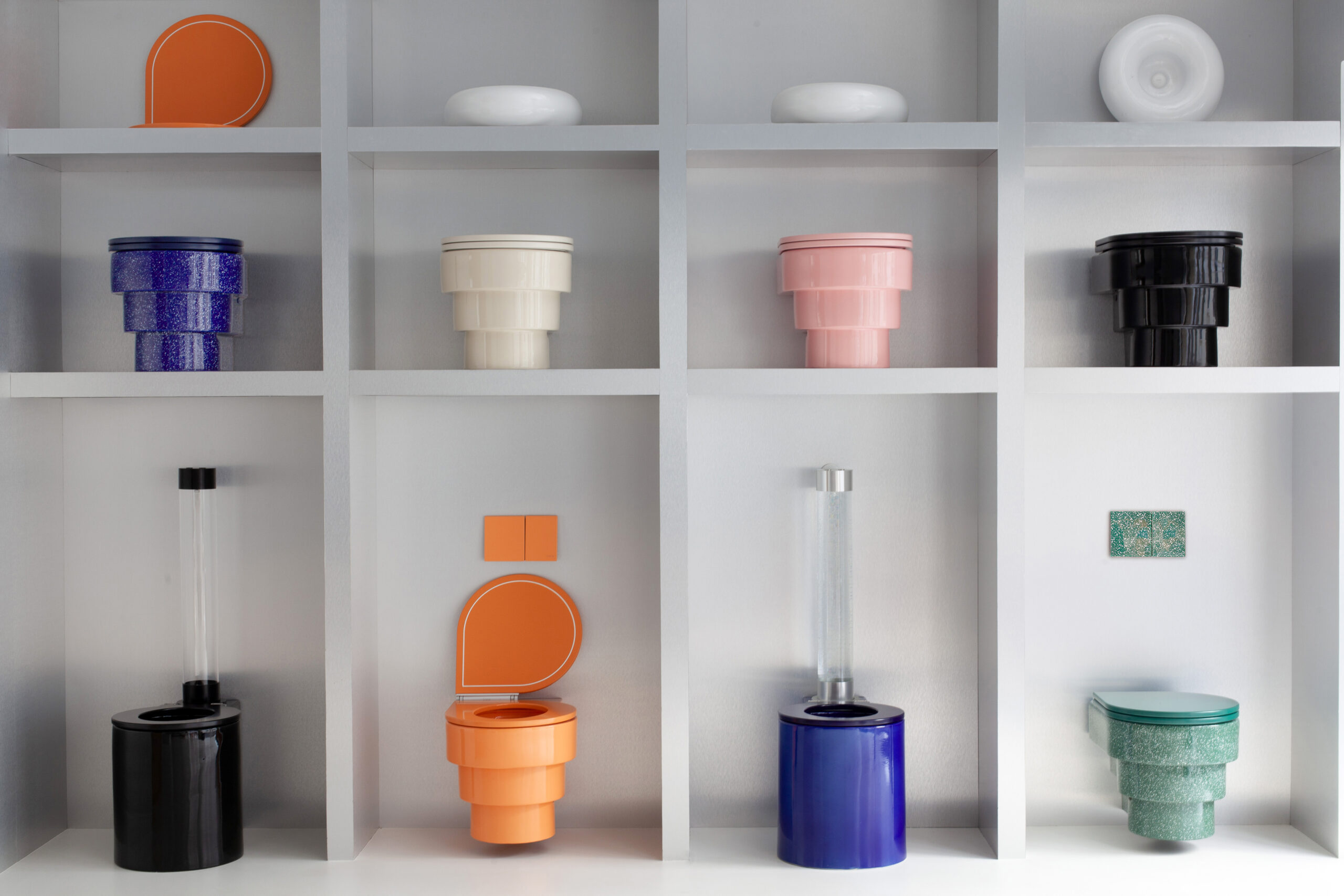
That illusion required the technical elements to all but disappear. Joints are absorbed into the form, hinges are concealed, and the seat follows the ceramic body. Even the quick-release mechanism, which eases cleaning, is integrated without breaking the geometry. Orgueil comes in seven colours: white, cream, black, blue, peach, pink and flaked green.

Orgueil makes more sense when viewed within the larger Trone universe. Founded in Paris in 2018 by Hugo Volpei, the brand began with a question that sounds almost absurd until you think about it: why had an object used every day remained largely untouched by contemporary design?
The idea originated during Volpei’s visit to Sketch in London. Its now-famous futuristic bathroom was spectacular, yet inside the theatrical egg-shaped cubicles he found completely conventional white toilets. The disconnect between an extraordinary interior and its most important functional object eventually became the starting point for Trone.
 Hugo Volpei
 The Callipyge toilet
The brand’s answer came first with Icone, with its transparent water column and coloured ceramic, then Callipyge, whose asymmetrical, three-tiered body reads almost as ceramic sculpture. Trone has since expanded into basins, mixers and accessories, building a complete bathroom collection rather than treating each object in isolation.
Its pieces are designed in Paris and made in Europe using traditional ceramic processes: moulding, drying, glazing and a 24-hour firing at 1,270°C, which gives the saturated colours and glossy surfaces their depth.
Orgueil ultimately captures what makes Trone interesting beyond the novelty of a beautifully designed toilet. The brand is questioning a hierarchy we rarely notice in interiors, the assumption that some objects deserve creative expression while others should simply do their job.
 The Orbe basin
 The Icone toilet