Words by Avishag Elkayam
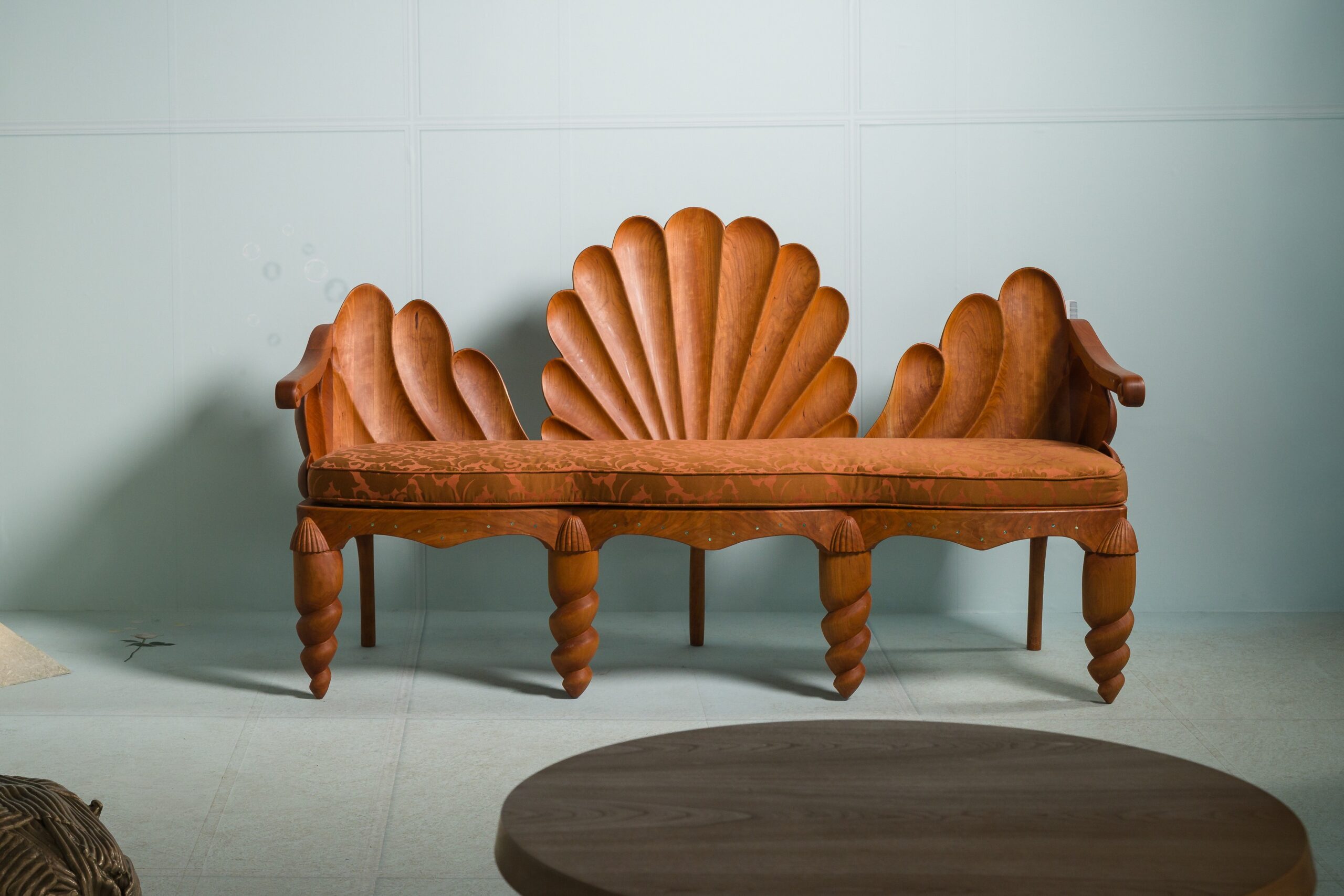
Beverly and Nancy are snails. They are also shelves, carved by hand from solid wood, and they are named after Miles Lawton Gracey’s grandmothers. “I imbued some of their essence into the snails bearing their names,” he says. “Those two are extra special to me.” Every snail in the series has a name and a personality of its own, and together they seem to belong somewhere between a living room and a storybook: playful, a little strange and deeply personal. In Gracey’s work, the line between furniture and sculpture is rarely where you expect it.
 Photo by Katy Anderson
He came to that freedom slowly. Gracey has worked with wood for about fifteen years, starting out sweeping workshop floors and learning from the craftspeople around him. Classically trained in furniture and cabinetmaking, he spent his early years mastering traditional technique, seeking out exotic timbers and ever more complex methods of construction. Over time, perfection began to feel less like a goal than a limit. “I found that the pursuit of precision and complexity was taking my work further away from the things I realized I actually cared about and wanted to communicate,” he says.
The change was also a personal one. After a traumatic experience, Gracey needed a way to work through emotions that conventional furniture making had no room for. He found himself thinking about his family, and especially about a late grandmother whose way of meeting loss with stories had stayed with him. Her example led him to rethink how memory, creativity and the objects around us are connected. Proportion and function stopped being the point; each piece became a story to tell. “It’s always about the story for me. That comes first,” he says. “Functionality is a fun attribute to explore, but it’s always an adjective to add to the narrative.”


The snails are the clearest expression of that idea, and their names are no gimmick. Each one emerges as Gracey gets to know the piece during the carving, the way a writer might name a character only once they understand it. The result is furniture with a sense of humor and a sentimental heart, closer to a companion than an object.
Fiction matters to him as much as craft. Rather than looking to other furniture makers, Gracey draws on literature, fantasy and storytelling. A piece begins as a loose sketch that leaves room to improvise. Working entirely by hand, with chainsaws, chisels and gouges, he lets the character of the wood have its say in the final form. “I have a rough idea about where I want to end up, but for me, it’s no fun to know the answer to every question,” he says. Carving is a reductive process: what is cut away cannot easily be put back. For Gracey, that turns the unexpected mistake into something closer to a discovery.
 Photo by Simon Leung
The same openness shapes how he thinks about furniture once it leaves the workshop. He is fascinated by the marks a home leaves on its objects: scratches across a wooden floor, water rings on a coffee table, upholstery worn thin with use. Where others see damage, he sees evidence of the lives lived around them. “Furniture is a witness to our daily lives,” he says. His pieces lean into that intimacy, offering themselves as participants in a household’s history rather than a backdrop to it.
The past year has brought a run of firsts: his first international exhibition, his largest commission to date and his first experience of teaching. Rather than settling, he is looking further out. He wants to carve larger works, take on animals he has not yet explored and bring new myths into the workshop. However far the work travels, its center holds. In Gracey’s hands, technique serves something more personal, and wood becomes a way of keeping memory, imagination and the bonds we form with the things that share our homes.