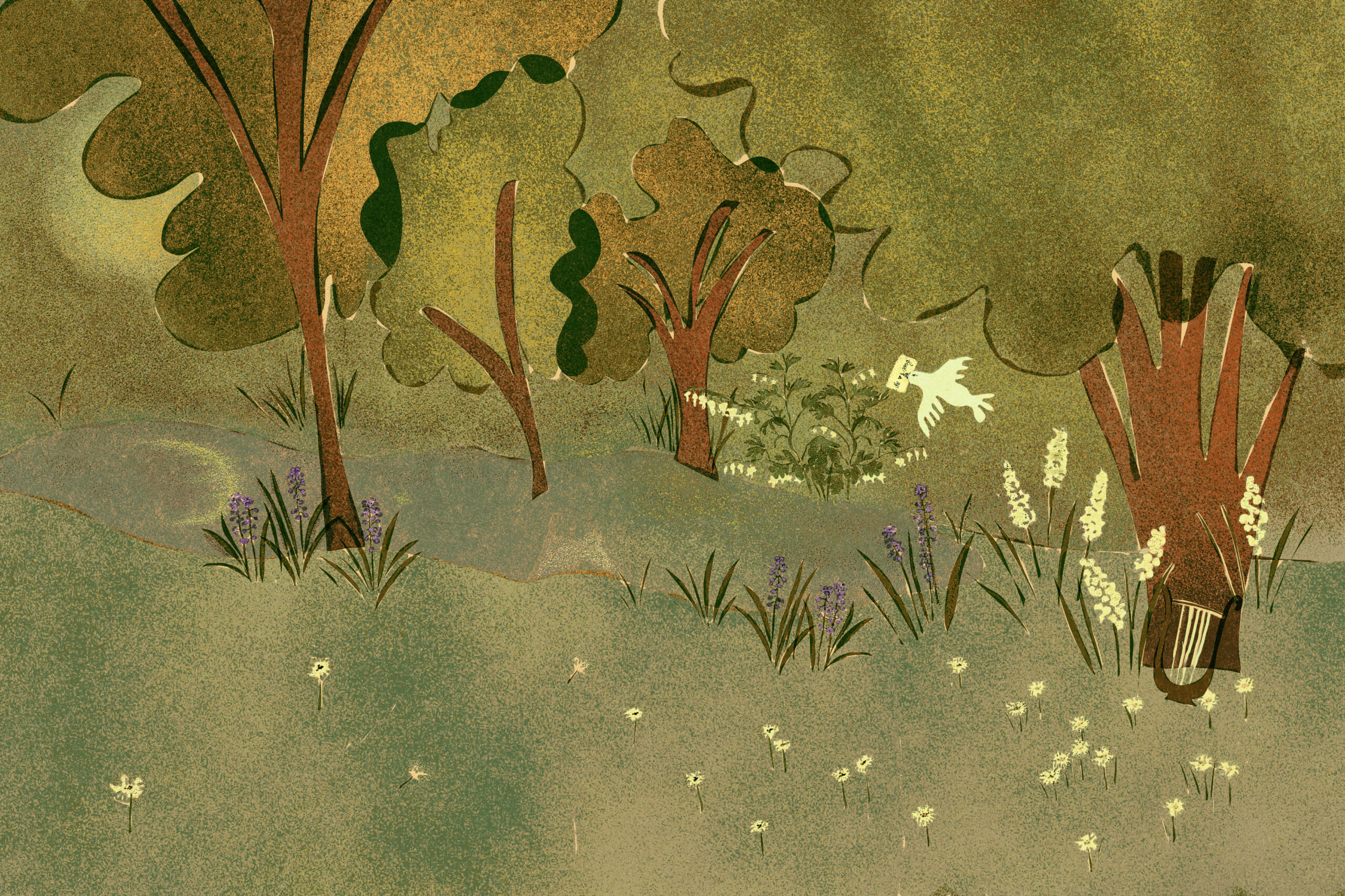
The Slovenian artist and designer brings illustration, mythology, and storytelling into the world of functional objects, creating pieces that carry meaning beyond their everyday purpose.
Words by Avishag Elkayam
What if a bathroom sink could tell a love story, or a mirror could hold the memory of someone dear? For Slovenian artist and designer Alja Horvat, these ideas form the foundation of a practice that brings illustration, sculpture, and functional design together. Based in Slovenia, Horvat has spent the past eight years working in illustration and textile design, collaborating with international names including Anthropologie, Urban Outfitters, FILA, Disney, and Vichy. Her creative journey began in childhood and continued through formal design education, but after years of working in two dimensions, she became curious about bringing her illustrated worlds into physical form. “Over time, I started to feel increasingly limited by working only two-dimensionally and became interested in what would happen if the worlds I was illustrating could exist physically,” she explains.
Rather than treating illustration and object design as separate disciplines, Horvat approaches them as complementary forms of storytelling. Her creative process often begins with a feeling, a phrase, or a narrative, followed by sketches, miniature clay models, and digital development using Blender. She is particularly interested in combining digital techniques with traditional craftsmanship, exploring how illustrated lines can be carved, engraved, or incorporated into an object’s surface. “I try not to begin with what is currently fashionable or what an object is expected to look like. Instead, I ask what it would look like if it belonged completely to that world,” she says. This approach allows her to develop objects according to their own visual logic rather than conventional design expectations.

Greek mythology plays a central role in Horvat’s work, particularly stories exploring love, devotion, and loss. Her Cupid Sink draws inspiration from the myth of Cupid and Psyche, with the sculptural form referencing Cupid while the engraved illustration represents Psyche’s perspective. Another significant piece is the Locket Mirror + Sink, inspired by the sentimental tradition of carrying portraits of loved ones inside lockets. Its illustrations reference the tragic story of Orpheus and Eurydice, introducing themes of memory and connection into an everyday bathroom object. “I wanted to reinterpret that idea through a mirror, where one side is for you and the other is for someone you love,” she explains. For Horvat, these references are not simply decorative additions but essential parts of each object’s identity.
Nature, botanical forms, and celestial imagery also influence her designs, appearing in pieces such as the Saturn Lamp and Forbidden Tree Lamp. Across her work, Horvat challenges the idea that functional objects must be visually restrained. “I don’t see functionality and decoration as opposites – they can strengthen one another,” she explains. Her approach responds to what she sees as the increasing visual anonymity of everyday objects, from lighting and furniture to sinks and architectural details. By introducing ornament, symbolism, and expressive forms, she aims to make these familiar elements feel more personal without compromising their intended purpose.


Although much of Horvat’s portfolio currently exists as detailed 3D visualizations, several designs are progressing toward physical production. A prototype of the Locket Mirror + Sink is currently underway, alongside the development of the Saturn Lamp, Forbidden Tree Lamp, and smaller jewelry boxes featuring apple and refrigerator designs. Her rattan four-leaf-clover armchair has already reached the prototype stage, while the sinks require additional technical development to ensure full functionality. These projects represent an important transition from imagined objects to pieces intended for everyday use.


Horvat’s ambitions extend beyond individual objects. She is currently renovating her own 1920s house, using it as both a personal home and an experimental space where she can develop furniture, lighting, mirrors, sinks, and architectural details. “It gives me the opportunity to design things I’ve always wanted to live with but could never find,” she says. Looking ahead, she hopes to apply this approach to complete interiors, particularly retail and public spaces, where every element contributes to a shared visual narrative. “Ultimately, I want to explore what happens when the visual world I’ve been creating through illustrations and individual objects expands into an entire space that you can physically step into.”