Words by Avishag Elkayam
Some designers create interiors; others create objects. Szymon Keller moves almost instinctively between the two. In his work, a room can begin with the memory of a Mediterranean summer, while a side table might emerge from an experiment with resin, light, and heat. Together, they form a design language less concerned with categories than with atmosphere.
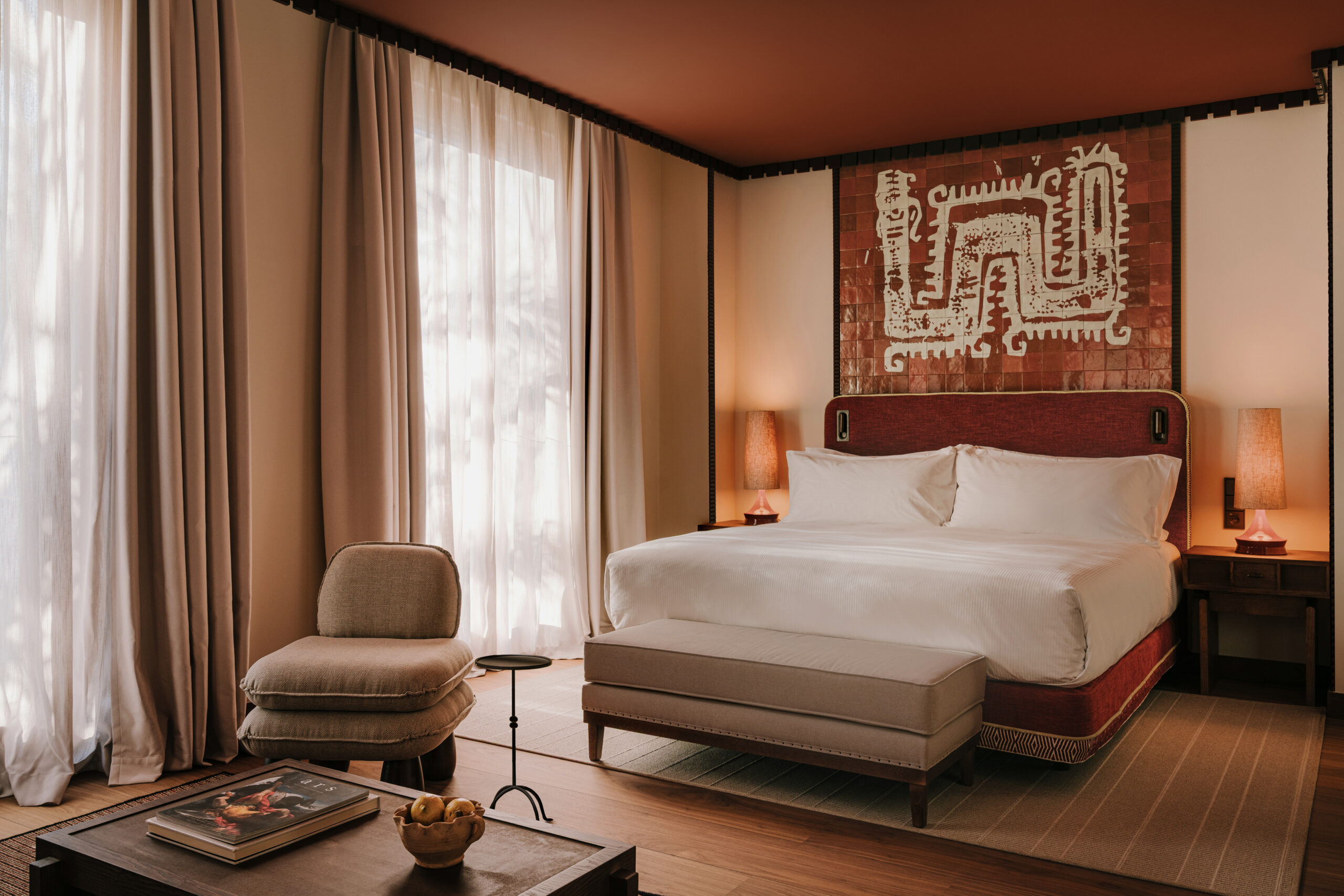
 Palacio de Godoy
Born in Pomerania, on Poland’s Baltic coast, and based in Barcelona since 2014, Keller holds a double master’s degree in interior architecture and design from the Academy of Fine Arts in Warsaw. Before establishing his own practice, he worked in studios in Barcelona, Warsaw, and Stockholm, across residential, hospitality, and commercial interiors, including international projects for Marriott, Hilton, Hyatt Regency, and Waldorf Astoria. That growing presence has earned him a place on AD100 Poland 2026, the annual selection of the most influential names in contemporary architecture and design.
Today, his studio works across interiors, collectible design, and bespoke pieces. At its core is an approach Keller describes as cultural: each project begins with research into place, history, and identity, and those references are then translated into materials, forms, and objects. His Barcelona space serves as both design studio and workshop, allowing ideas to move from sketches and material experiments to prototypes and finished pieces.
 Szymon Keller
 The "Lung 1.0" Side Table
That approach is especially visible in Waves House, a 60-square-meter apartment in a 19th-century building in Barcelona’s Eixample, conceived as a portrait of summer. Rather than referencing the Mediterranean literally, Keller translated memories of sea, sand, and sunset into curved architecture, sandy stucco, copper, terracotta, and deep marine greens. Arched openings and rounded forms create a fluid path through the apartment, while a copper bathtub glows against dark green tiles like an object discovered underwater.
In Casa Soleil, designed in collaboration with Madeux Studio, memory once again becomes part of the architecture. Mediterranean references meet the owner’s European and Middle Eastern roots through soft arches, natural materials, and carefully chosen art and furniture. Several of Keller’s own collectible pieces are integrated directly into the home, dissolving the boundary between designing a room and designing what lives in it.
 The Wave House
 Casa Soleil
His hospitality work extends the same idea to a much larger cultural narrative. For Palacio de Godoy, a historic palace in Cáceres transformed into a hotel, Keller drew on the journey of Francisco de Godoy between Extremadura and Peru. Local granite, clay, and wood meet Peruvian textiles, geometry, and craftsmanship, while contemporary art and custom furniture sit within centuries-old walls. The result is not a historical reproduction but a dialogue between places and periods.
 The "Ruins Coffe Table 3.0" at Casa Soleil
 Collectible Objects by Szymon Keller at the Palacio de Godoy
Keller’s collectible work feels like a concentrated version of these interiors. Nature, memory, and material experimentation are recurring starting points, and imperfection and unpredictable processes are allowed to shape the final form.
The Ruins series explores erosion and decay through sculptural pieces inspired by architectural fragments and by rocks shaped by water. By contrast, the translucent resin Lung side table feels almost biological, recalling a jellyfish or some other marine organism. Its form emerged from experiments with resin at different temperatures, letting the deformation that occurs as it solidifies become part of the design rather than something to eliminate. The Sunburst sconce, meanwhile, combines resin, neon, and iron to capture the fleeting experience of a sunset in gradients of amber and light. These objects are functional, but function never tells the whole story. A table can behave like sculpture, a lamp can become an atmospheric installation, and an interior can work almost like a portrait.
What makes Keller’s practice compelling is precisely this refusal to draw a hard line between architecture, furniture, and art. His interiors provide a context for experimentation, while his collectible pieces give physical form to the memories and narratives behind those spaces.
Whether working within the walls of a centuries-old palace or with the fleeting memory of sunlight on the sea, Keller seems drawn to the same question: how can something intangible become material? His answer lies somewhere between craft and experimentation, past and present, object and space, in environments designed not simply to be seen but to be felt.
 Palacio de Godoy