From the silver-sheathed lighter to the sculpted horn comb: why the women of the 1920s turned every everyday gesture into a small performance, and why a whole generation is now returning to objects that ask us to slow down.
Words by Ofri Weintraub
To understand why these objects mattered so much, we need to step back a few years. After the First World War, women left the house in numbers never seen before: for offices, for cars, for jazz clubs. Hair got shorter, hemlines rose, dresses became straight and light, and usually had no pockets. What had once happened behind the closed door of the dressing room, powder, lipstick, a last glance in the mirror, suddenly moved to the restaurant table. The private act became public, and when something is done in front of strangers, it is no longer enough that it works. It also has to look good. So began one of the loveliest moments in design history, when Art Deco, with its geometry, clean lines and precious materials, met the smallest objects a woman carried with her.
 Greco Case by Juju Vera
On Easter Sunday 1929, a group of young women walking down Fifth Avenue in New York stopped in front of the crowd and lit cigarettes. The newspapers called them “torches of freedom.” Only later did it emerge that behind the gesture stood a publicist named Edward Bernays, hired by a tobacco company that wanted to double its market. But even if the script was written in an office, the gesture itself was real. A woman lighting a cigarette on the street, in a café or at the bar was declaring that public space belonged to her too. And the moment she took out the cigarette, she also took out an object.
The silver cigarette case may be the perfect example. Engraved vertical lines, a clasp that shuts with a quiet click, and inside a metal bar holding the cigarettes in a row. There were also metal sleeves that wrapped the cardboard pack itself and sent a simple message: you don’t display the tobacco company’s brand, you display yourself. Beside it stood the lighter, and quite often a long cigarette holder in lacquer, tortoiseshell or bone. The Paris jewellery houses quickly understood that these objects were jewels in every sense. In the early 1930s Van Cleef & Arpels patented the minaudière, a hard metal evening box that replaced the handbag and held, in separate compartments, powder, lipstick, a mirror and room for cigarettes. The story told at the house is that the inspiration came from a woman who tossed all her small things into a tin cigarette box.
 Bird’s Eye Lighter by MISFIT RIOT
 Refillable luxury metal bronzer compact by FLUFF
The ritual didn’t begin on the street, though, but long before, at the dressing table. A silver tray with curled handles, a matching silver-backed brush, comb and mirror, often engraved with a monogram. Cut-glass perfume bottles, small boxes in enamel and lacquer, mother-of-pearl dishes and shells that opened like jewels. And behind it all stood the screen, a folding, ornamented partition that divided the room and turned getting ready into a semi-private theatre. Designers such as Eileen Gray and Jean Dunand made lacquer screens into objects that now hang in museums. And the powder compact, perhaps the most intimate object of all, was designed from the start to be refilled. You didn’t buy a new compact when the powder ran out. The object stayed; only its contents changed.
Why then, of all times? Because in those years a personal object was a way to stake a claim. A woman who had just begun earning her own money, voting, driving and sitting alone in a café carried a whole world in the palm of her hand. Opening a compact at the table gave her a few seconds of sanctioned pause, a chance to look at herself in public without apologising. The lighter and the case told the world who she was without her having to say a word. These weren’t accessories. They were delicate armour, and also small companions that stayed with you for years.
 Pocket-sized sandalwood comb with a hand-tied tassel by ETAAT
A hundred years later, something in that gesture is returning, and this time the cigarette is beside the point. A generation raised on GRWM videos, on bathroom shelves arranged like exhibitions and on the word ritual in every product description is looking for exactly what these objects offered: a moment you can’t scroll past. ETAAT, for instance, which describes itself as a sculptural beauty brand, makes hand-carved horn combs in small batches, inspired by gallery arches and the lines of classical monuments. The brand speaks openly about turning everyday grooming into a quiet ritual, and its combs are now sold at FWRD as a fashion item in their own right.
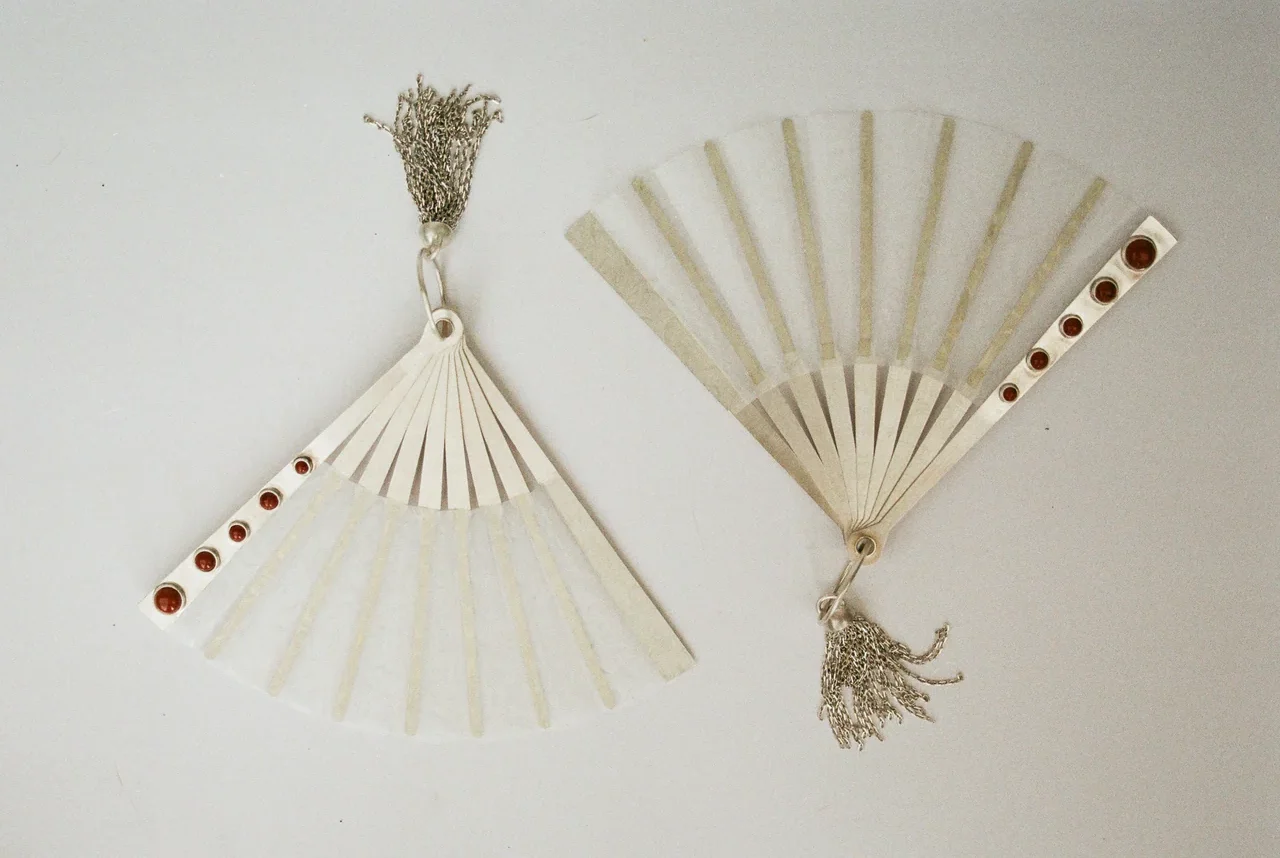
New York-based Juju Vera has taken up the language of the cigarette case almost word for word: a handmade lighter case with an Art Deco shell at its centre, vertical lines and a hidden click-lock, sized exactly for a standard Bic lighter. Christian Louboutin has designed a silver lighter sheath that hangs from a chain. And at the concept store Casa Shop you’ll find a small handmade silver fan by the Polish studio Forge Objects, set with carnelians and finished with silver tassels. Vintage shops have understood the power of the moment too. They are importing silver trays, cigarette cases, compacts and combs of the period from Europe, and what was once sold at flea markets as a grandmother’s odds and ends now sits in the shop window as a collector’s piece.
 Decorative folding screen at Mishimono store, in collaboration with Rotem Lebel
 Sterling silver folding fan by Casa Shop
And then there are the tassels. Almost every one of these objects, then and now, has a tassel hanging from it: black silk on a lighter case, white silk swaying beneath a mother-of-pearl shell, fine silver chains falling from a fan. In the 1920s the tassel wasn’t mere decoration. Compacts and vanity cases hung from silk cords worn on a finger or around the wrist, and the tassel at the end was what turned a practical object into a moving piece of jewellery. It is tied directly to the flapper dress with its fringes that danced the Charleston, to movement, to a body finally set free. Perhaps that is what it does today as well. A comb or a lighter is a static object. A tassel gives it softness, weight, something to hold on to. It turns an item forgotten at the bottom of a bag into an object you want to take out and set on the table.
Perhaps that is the secret of the comeback. We live in a world where almost every action passes through a single screen, smooth and identical for everyone. An object that demands two hands, a few seconds of attention and a metallic click returns to the body something that was being lost. Most of the new lighter cases will end up lighting candles, not cigarettes, and the refillable compact of the 1920s is now called “sustainable.” The cigarette can stay in the 1920s. The gesture is worth taking with us.