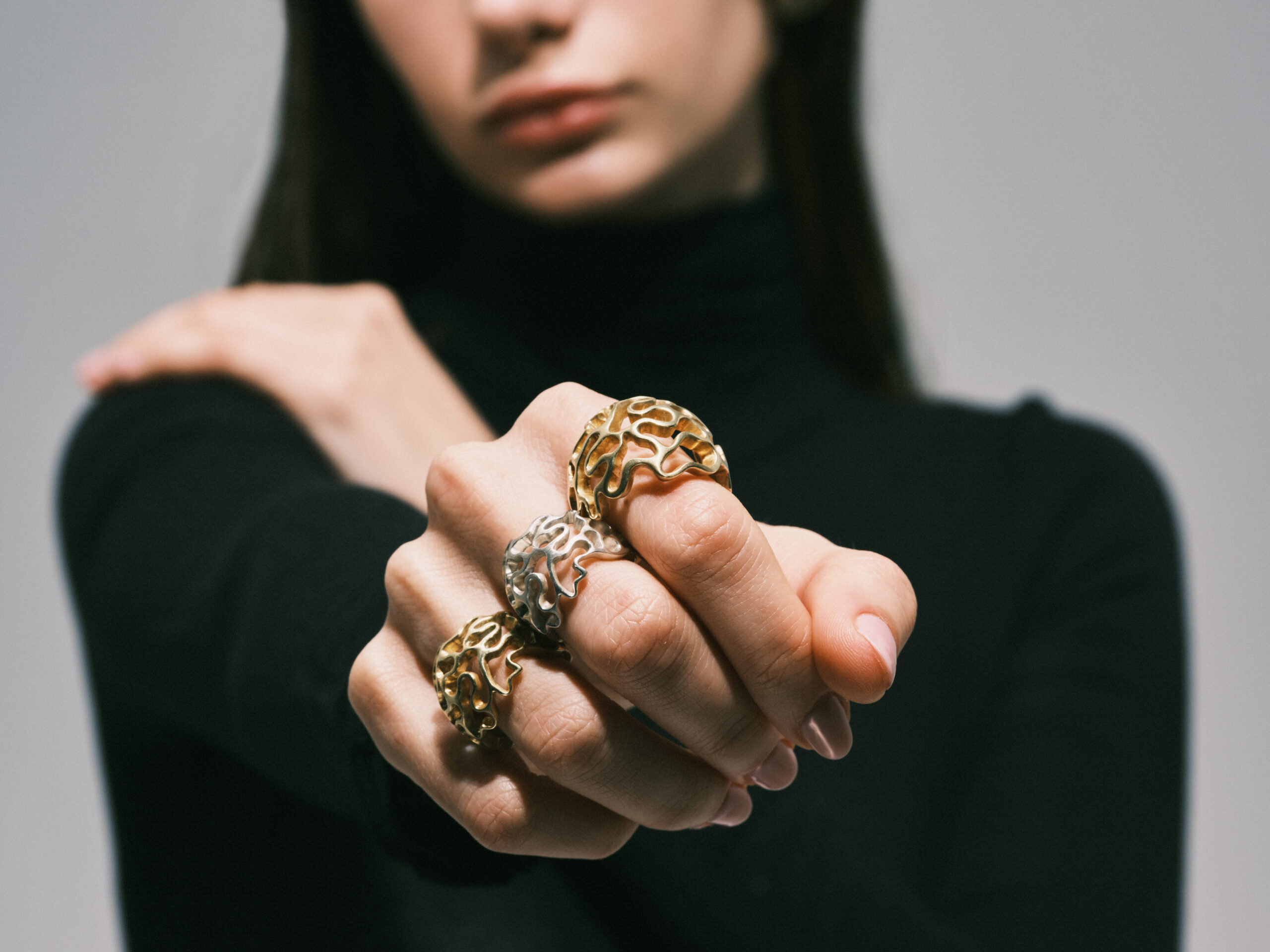
You may already be wearing a stranger. It goes everywhere with you, and some nights you forget to take it off, the way you forget you have a finger. The label said sterling silver, and that was the end of it. But a label only names a thing. It says nothing of where it came from, or whose hands it passed through. What follows is closer to a recipe: one ring, made by my mother and me in our Paris studio. The ingredients are a pencil, twenty-two grams of silver, a kiln, a bucket of plaster, patience, and the willingness to begin again.

It starts with a drawing, perhaps the most dangerous stage of all, because it costs nothing. With no material to waste, nothing stops the hand from wandering. The Surrealists called this automatic drawing: let the hand move before the mind can edit. The result is rarely polished, but almost always honest. I often think of Dürer’s Praying Hands, a study for an altarpiece later lost to fire. The altarpiece is forgotten. The study became one of the best-known images in Western art. Every piece I make begins this way, in pencil lines no one will see.
From the line, a body must rise. Every jewel has a first body made of wax. For millennia it was carved by hand, and every cut bore witness to the hand that made it. Lost-wax casting has barely changed since, but the way the wax takes shape has. Today a form can be tested on screen before it exists, then printed in wax, one fine layer at a time. Iris van Herpen showed that 3D printing is not a shortcut but a language for forms the hand cannot reach alone. Still, precision is not perfection. The printed model must be held, turned in the light, judged by fingertip, and often printed again. Only the version that survives moves on.
 Model illustration
 Wax tree
Rings are rarely cast alone. Several wax models are joined into a structure called a tree, each one a branch attached to a central trunk by a thin channel that will carry the molten metal. I trained first as an architect, and this is where that training returns, because nothing about this tree is natural. It is engineered. If a channel is misplaced, air gets trapped, metal cools too soon, and the farthest point never fills. The tree is set in a steel flask, plaster is poured around it until the wax disappears, and then we wait, ideally overnight.
By morning, the ring still doesn’t exist. The flask spends eight to twelve hours in the kiln while the wax melts and burns away, leaving a hollow in the exact shape of what is to come. The first body must vanish before the metal can take its place. It is like a photographic negative: the mold holds the ring by holding its absence.
 The pour
 The burnout
After nearly forty hours, everything comes down to half a minute. The flask goes straight from the kiln into a vacuum caster as the silver melts, passing from red to orange to near-white, and at around 893°C it is poured. The vacuum helps, but there is no bargaining with metal. Air can be trapped, an edge can refuse to fill, and porosity may reveal itself only later, under polish. As it cools, silver contracts, so the ring is slightly smaller than the body that made it. Physics, too, has a hand in the design.
The birth is not beautiful. The hot flask is plunged into cold water, and the plaster cracks away to release the metal. What protected the piece must be destroyed. What emerges is grey, scorched and still attached to its tree. This moment is rarely photographed because it breaks the fantasy of the finished object. To me, it is the most honest one.
 The reveal
 Finishing
Then comes a small act of violence. The ring is cut from the channel that fed it and becomes, for the first time, its own object. The stub must be removed completely, or it becomes a weak point. The surface is filed, sanded with ever finer papers and polished until the silver returns the light. But the organic hollows of our pieces are beyond any machine’s reach, so my mother and I finish them by hand, passing each ring between us. The standard is tactile as much as visual. It has to feel right.
Gaston Bachelard wrote that small things can hold vast interior worlds. A ring lives at that scale: small enough to close a hand around, large enough to enter through touch. It is discovered slowly, through curves, shadows and hidden recesses, and that is what I want from my work: an object you keep discovering, not one you simply display. Brancusi polished his bronzes until their surfaces seemed endless, until they became sensation. The final polish on a ring does the same. It is not decoration. It turns metal into feeling.

None of this is visible in the end. That is the point. In Ovid’s Pygmalion myth, the sculptor’s ivory figure comes to life first beneath his hand, softening and growing warm. The object becomes real through touch. A ring does something quieter. It passes from the maker’s hands to the wearer’s finger, and waits for skin.
So next time, run your thumb along its curve. The metal will warm, and what returns is not quite a memory but the presence of its making: the fire, the waiting, the care given to details too small to announce themselves. All of it held in a band of silver no wider than a finger, older than your morning and steadier than your day.
 Nowar Sadi
 is a Paris-based multidisciplinary designer working across architecture, fashion and jewelry. Trained in architecture and later at the Institut Français de la Mode, she explores sculptural form, materiality and the relationship between objects and the body. Her independent brand, Nowar Studio, creates future-organic pieces meant to be touched as much as worn, each one made by hand, in-house, by Nowar and her mother.