With his new Unalome collection, Thai designer Saran Yen Panya turns a sacred visual motif into twelve playful chairs, and asks who gets to decide what good taste looks like.
Words by Avishag Elkayam
Some chairs are designed to disappear into a room. Others are determined to become its most interesting guest. Saran Yen Panya’s Unalome chairs firmly belong to the second group: looping backrests, unexpected color pairings, embroidered seats featuring everything from flowers to flamboyant animals. Beneath the eccentric surface, though, lies a thoughtful study of cultural identity, traditional craft and what contemporary Thai design can be.
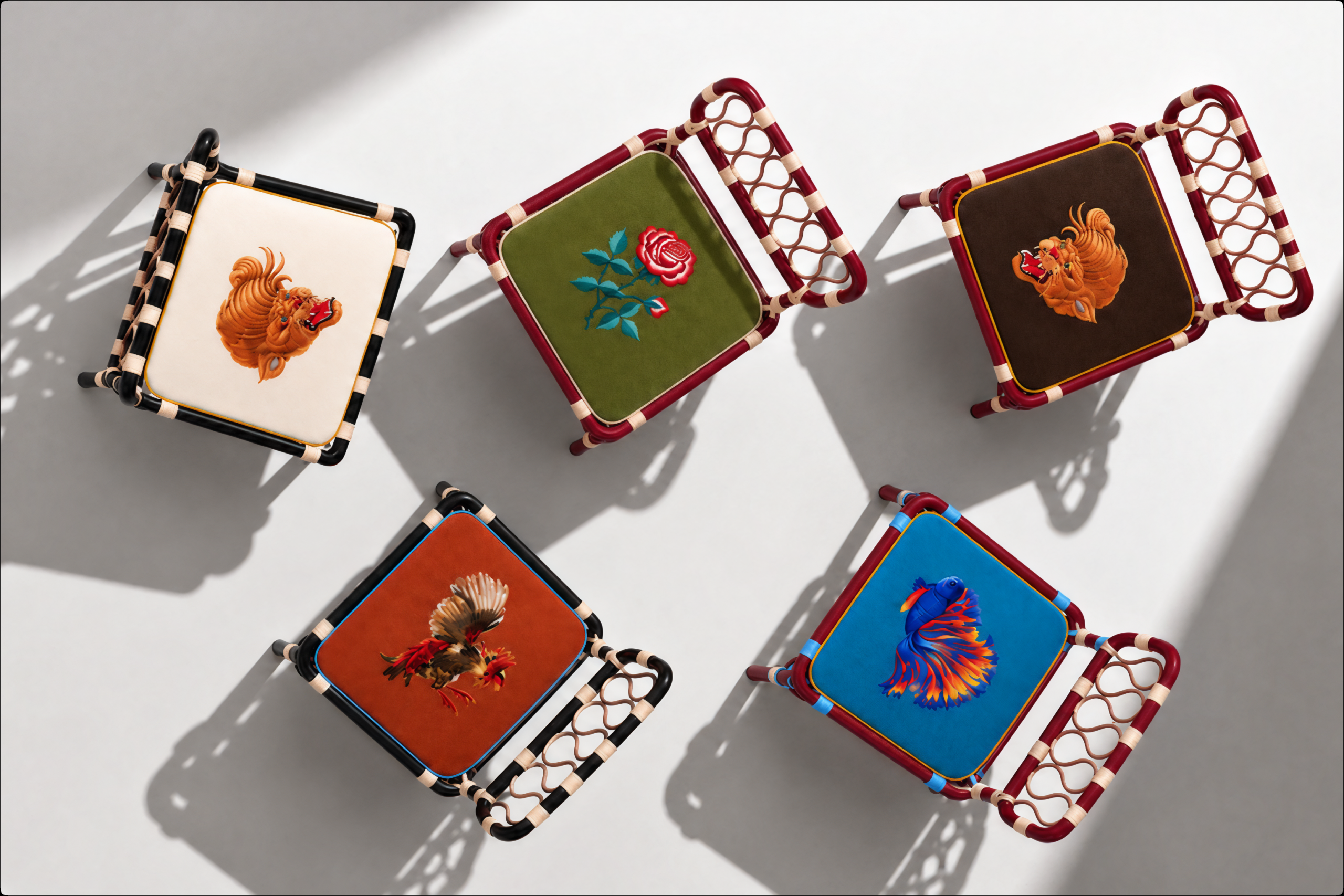
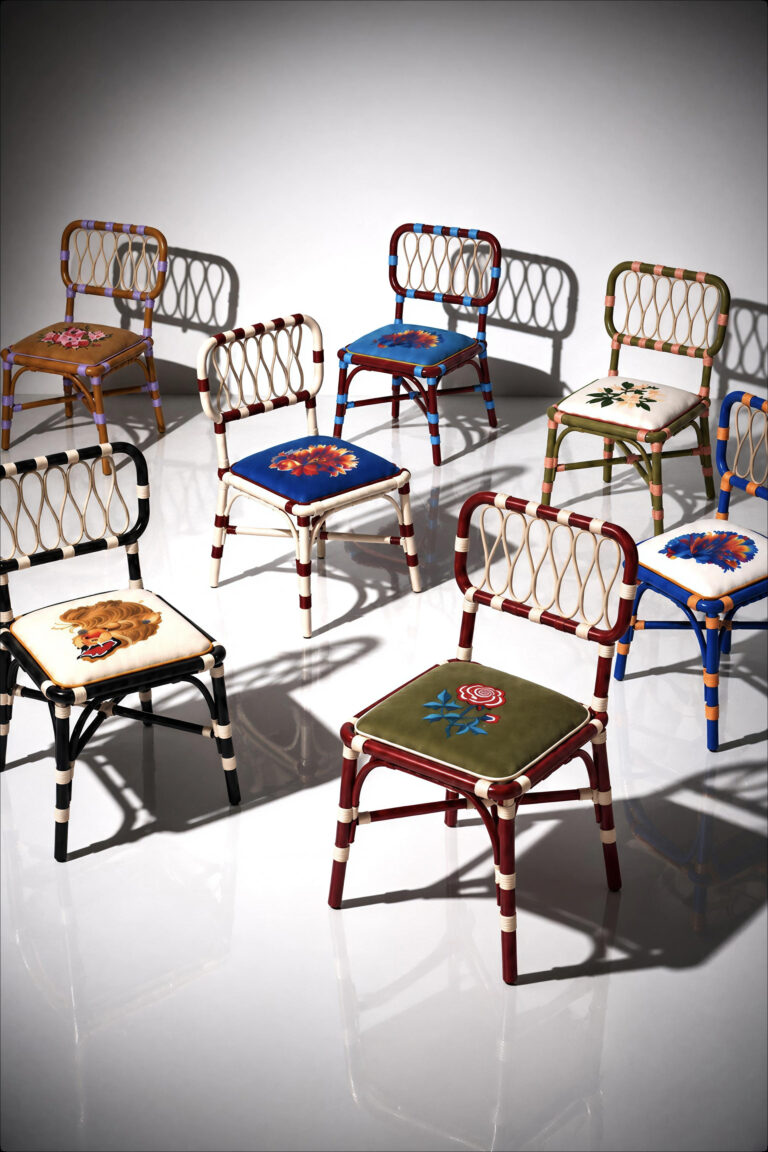
Launched on October 7 under the designer’s SARANYEN label, Unalome comprises twelve variations on a single chair. Every one shares the same silhouette, and every one has a personality of its own.
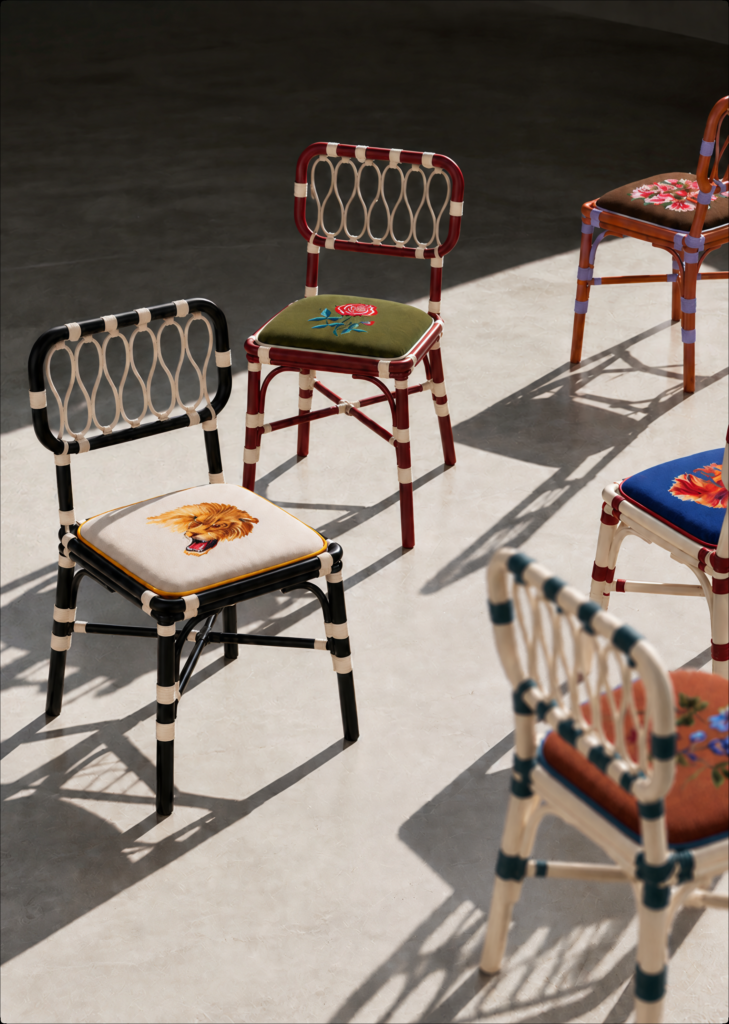 "I tend to think of furniture as characters rather than objects. A chair can be elegant, ridiculous, romantic, rebellious, or slightly obnoxious. Just like people."
It all began in an unlikely place: a class in traditional Thai yantra drawing. “My teacher was teaching me about lines. When to bend, when to resist, and when to flow,” Panya recalls. “It sounds rather philosophical, but I found it fascinating that something as simple as a line could carry so much meaning.”
The collection is named for the unalome (อุณาโลม), a sacred motif that runs through Thai spiritual and visual traditions. Rather than using the symbol as decoration, Panya was drawn to its movement and rhythm. He set himself the challenge of turning a two-dimensional line into a three-dimensional object.
הצגת פוסט זה באינסטגרם
The result is a slender tubular frame, a looping backrest of woven synthetic rattan and an upholstered seat. The structure never changes, while the color, weaving, bindings, textiles and embroidery always do. “I tend to think of furniture as characters rather than objects,” he says. “A chair can be elegant, ridiculous, romantic, rebellious, or slightly obnoxious. Just like people.” Some versions pair muted tones with delicate floral embroidery. Others commit fully to saturated color, contrasting bindings and animal motifs. The unpredictability is the point: a coherent design identity, Panya suggests, need not be a uniform one.
The chairs are produced by Hawaii Thai, a long-established Thai manufacturer specializing in synthetic rattan. Panya had known its owner, also a co-founder of architecture firm PHTAA, for years before the two finally decided to work together. The company combines metal frames with bending, wrapping, weaving and binding, and has developed its own synthetic rattan, Durawera, which extends what traditional weaving methods can do. For Panya, the partnership proved that established craftsmanship can enable experimentation rather than restrict it. Production, he says, was the easy part. The headaches came afterward, with international shipping, logistics and customer service.
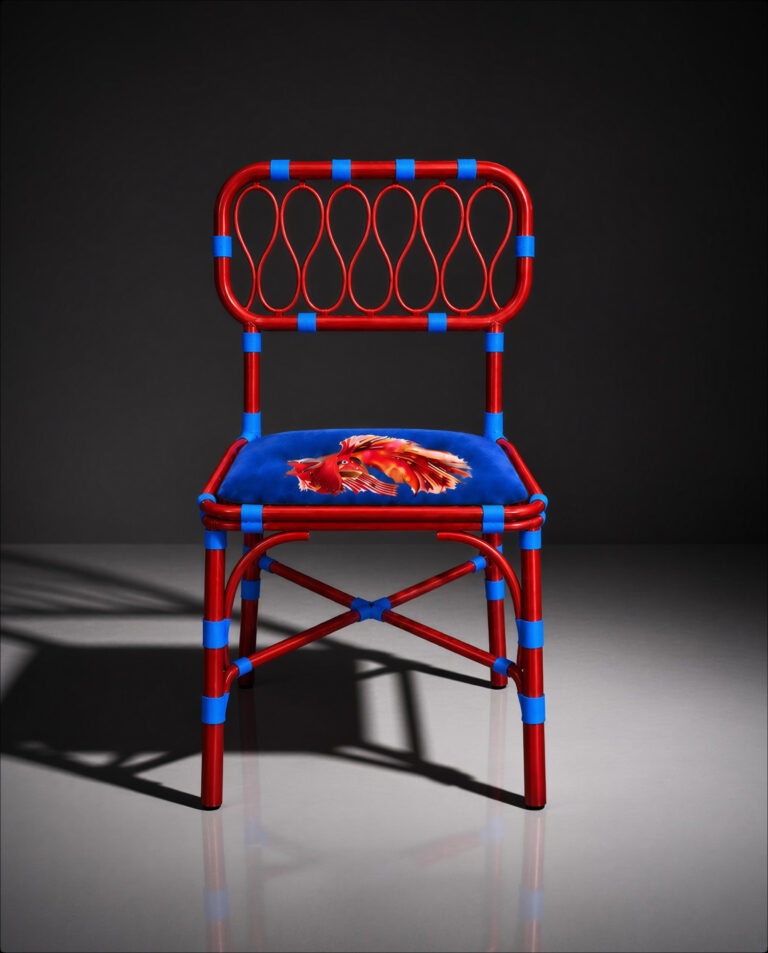
Unalome also raises the question of what makes design distinctly Thai. Panya’s answer has little to do with familiar imagery. “I’m Thai. I grew up surrounded by Thai visual culture. It’s already part of the way I see the world,” he says. “So I don’t necessarily feel the need to make something look traditionally Thai in order to prove that it’s Thai.” Instead, he takes familiar references apart and rebuilds them with contemporary materials, unlikely combinations and a healthy disregard for aesthetic rules.
That disregard has defined his career. He studied industrial design at Chulalongkorn University in Bangkok, then earned a master’s in storytelling at Konstfack in Stockholm. The combination taught him to think about the stories, emotions and cultural associations objects carry as much as how they function. He went on to co-found 56th Studio, a multidisciplinary practice spanning furniture, interiors, installations and visual storytelling. He has also worked with clients including Dior, Cartier, Hermès, Airbnb and Vogue Thailand.
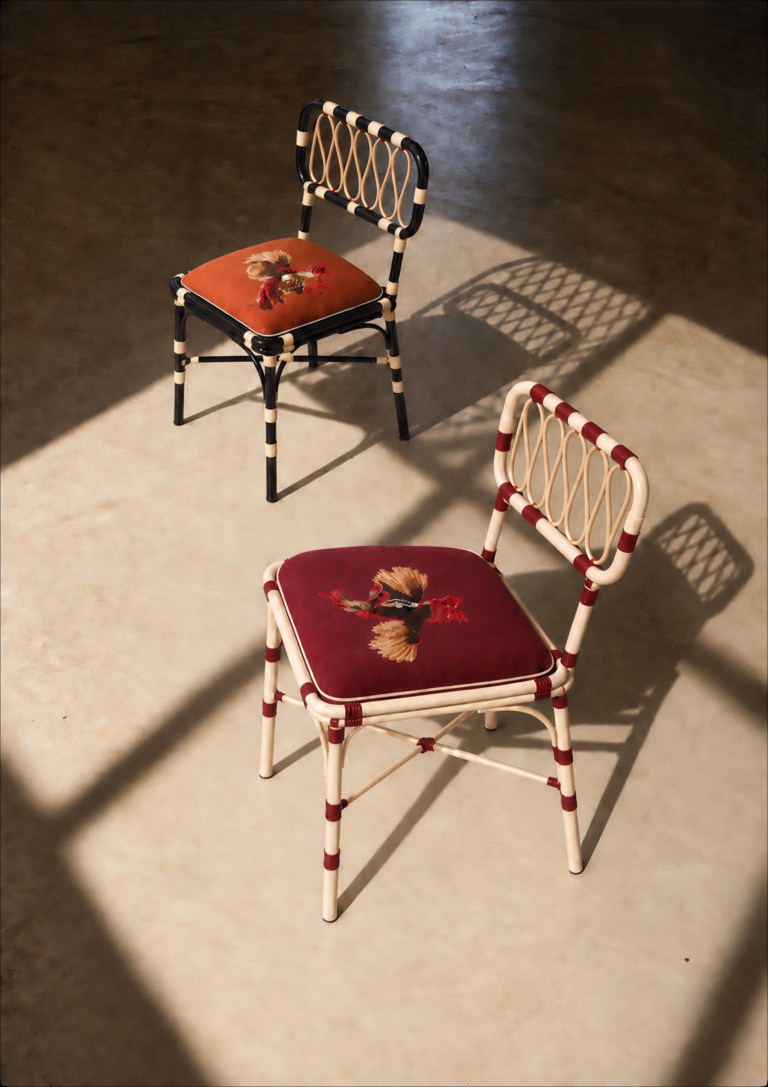
"Who decides what's tasteful anyway?"
Across all of it runs a fascination with everyday culture, nostalgia, humor and unconventional beauty. “I’ve always been fascinated by the relationship between good taste and bad taste,” he says. “Who decides what’s tasteful anyway? A lot of things we consider beautiful today were once considered vulgar, excessive, or completely ridiculous.” Rather than pursuing refinement for its own sake, Panya gravitates toward overlooked references and the decorative excess that conventional design tends to dismiss. Humor, for him, is a serious tool for communicating complex cultural ideas, but it is never the whole point. “I also believe design should create desire. Not just intellectual appreciation. Actual desire.”
That thinking now drives Yenniverse, Panya’s expanding creative platform, where single designs can grow into recognizable families of products. Unalome marks an important step. It is not a one-off chair for a single project, but an identity that can keep taking on new personalities while remaining instantly recognizable. “The chair becomes a kind of permanent character,” he says. “I find that possibility exciting because it allows a design to continue growing rather than simply becoming another object in an archive.”
Unalome is now available for international pre-order through Yenniverse, with worldwide shipping. It is unlikely to be the last chapter. Panya is already at work on new collections and collaborations spanning furniture, textiles, wallpaper and lifestyle objects. Some return to traditional Thai materials and craftsmanship, while others mine everyday domestic culture for the details most of us walk past without noticing. After almost two decades in the creative industry, what seems to interest him most is building a design universe that keeps evolving beyond any single project.
“I still love designing,” he says. “I just want my designs to work a little harder than I do.” Unalome does exactly that. Twelve chairs, twelve characters, all drawn from a single line, and each one a reminder that, with enough culture, craft and a little mischief, even an ordinary chair can have quite a lot to say.
הצגת פוסט זה באינסטגרם